In modern operational environments—whether on a tactical battlefield or a high-speed manufacturing floor—rapid decision-making is often hindered by a lack of computing power, bandwidth constraints, and the overwhelming proliferation of raw data.
The U.S. Department of Defense (representing the Army, Navy, and Air Force) launched the xTech Global AI Challenge to identify robust, AI-enabled solutions capable of processing disparate information sources at the absolute “point of need”. MarshallAI entered the competition to prove that highly accurate machine vision does not require months of training, massive datasets, or cloud connectivity.


The Concept: No-Code AI for the Frontline
MarshallAI proposed a platform designed for the total replication of human sensing by regular operators. The core philosophy was simple: an operator should be able to train and deploy an AI model without any prior understanding of machine learning and without writing a single line of code.
To demonstrate this, the team conducted a live, rapid-deployment pilot running entirely on a small, portable edge device.
The Live Demo: From Scratch to Deployment in Under 2 Hours
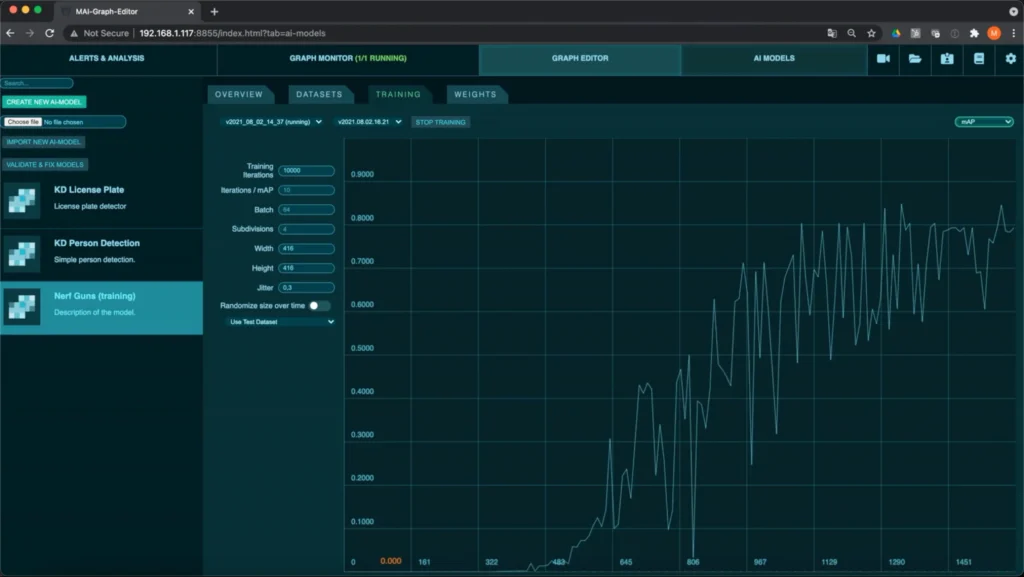
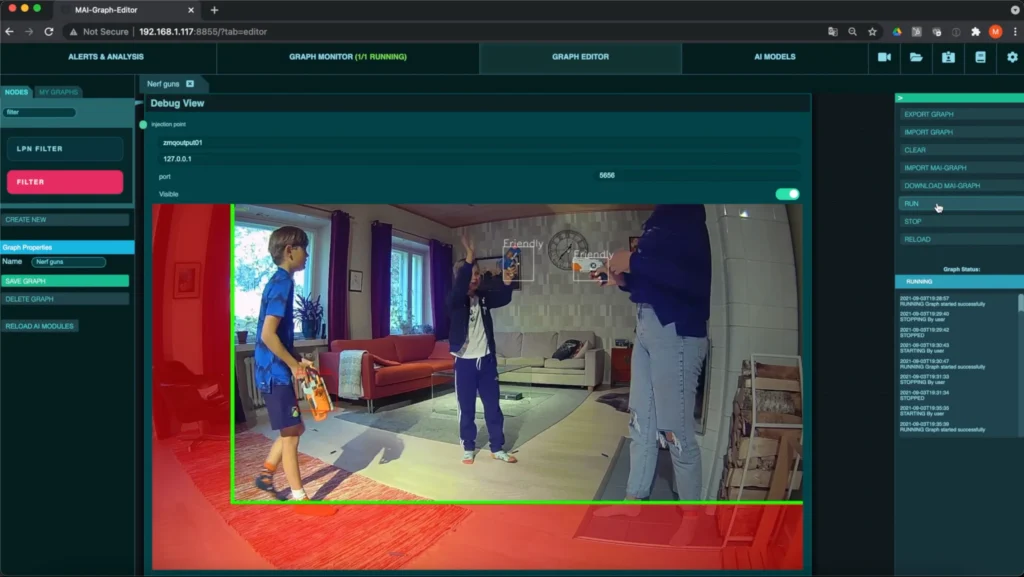
During the pitch, the MarshallAI team implemented a fictive use-case: detecting and distinguishing specific types of “hostile weapons” (Nerf guns) in real-time from an actively connected camera.
The metrics of the deployment showcased the extreme agility of the platform:
- Unprecedented Speed: The custom AI model was built entirely from scratch in just 1 hour and 40 minutes.
- Minimal Data Requirements: The deep learning model required only 77 reference images to achieve functional accuracy.
- Air-Gapped Security: The solution ran fully offline on a portable Jetson Xavier NX edge device, with absolutely zero connectivity to the cloud or outer networks.
- Instant Alerts: The localized network was configured to instantly send a text message alert the moment the designated object left the active field of view.
Results & Manufacturing Implications
MarshallAI won 1st Place out of all international finalists, receiving superior scores from the DoD judges for presentation, technology viability, and potential for impact. The U.S. Air Force AFWERX program publicly praised the platform’s “Configurable Deep Learning Pipelines”.
While the initial pitch focused on military situational awareness—providing “an extra pair of eyes” to patrolling units—the underlying technology translates directly to industrial environments. The xTech victory proves that the MarshallAI platform can rapidly adapt to novel visual challenges, process data locally on a factory floor or in the field, and seamlessly integrate alerts without requiring months of costly AI development.